This post is more than 14 years old
Politics move quickly and opinions evolve. There's a good chance I no longer hold some of the opinions expressed in the post below
—Mustapha
Clashes in Tripoli. Will There be a “Victory”?
August 22, 2012 · Mustapha Hamoui
This is not a post about right and wrong. I’m not here to ask who is to blame for the fights in Tripoli, or to rant about the powerless government and the sheer madness of urban populations lobbing grenades and missiles at each other. This post is simply to ask a question many of you are asking: Is there a point in this struggle? Is there a desired outcome in the mind of any of the two parties or is this just a mindless brawl?
One of the most shared tweets on Tripoli’s clashes last night was this one , which translates roughly as:
“This sounds like a battle with a decisive outcome in mind.”
Can we really have a “decisive outcome” in the clash between Bab el Tebbeneh and Jabal Mohsen or is the entire fight “pointless”, to use the word of prime minister Mikati? (المعارك العبثية)
The Tebbaneh mob vs the Jabal Mohsen fortress
To understand the nature of this fight, one must take a closer look at the two warring sides. On one hand, we have the Sunnis in Bab el Tebbaneh who support the Syrian revolution and hate the Assad regime to the bone. They are motivated by TV footage coming from Syria that shows the regime slaughtering their co-religionists. They are poor, but they have the will to fight and are generously armed with light weapons. They are also more numerous than their opponents and don’t follow a single chain of command.
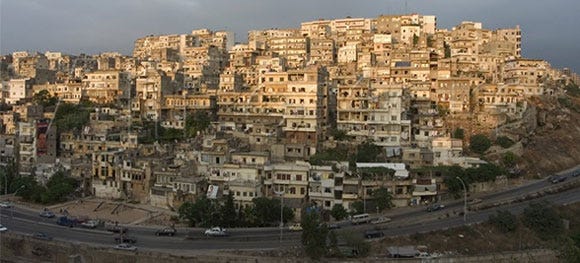
On the other side we have the Alawis in the Jabal. They support the Syrian president Assad so much that their streets are covered with his portraits. They have a small population compared to that of the Sunnis, but they have the strategic advantage of being on a hill towering over their opponents, making their location ideal for snipers and unwelcoming to “invaders”. They are well entrenched and have access to heavy weapons, provided to them by the Assad regime (and some say by Hezbollah) to protect this strategic outpost in hostile territory. Some cheeky commentators have implied that Jabal Mohsen is the Israel of Tripoli, ie a small state of a religious minority surrounded by enemies, which explains why it is armed to the teeth by a large protector. The fighters in Jabal Mohsen are under a unified command structure.
Motivation and deterrence
The Alawi community of Jabal Mohsen has so far survived the encroachment of the Sunnis and kept its cultural and political singularity despite its small size. It has done so through a combination of powerful weapons and the regular intervention of the Lebanese army to separate the two sides (which cost the Army sacrifices of its own). The balance of power has long been stable because the Sunnis didn’t have enough motivation to attack, and because the Alawis have a strong power of deterrence. But there are now reasons to believe that these two factors, motivation and deterrence, are shifting. The balance of power may well be altered soon.
First, motivation. To the Sunnis, Jabal Mohsen is starting to look like Damascus and Aleppo. These Syrian cities were long seen as impenetrable fortresses of the Assad regime, but are now unraveling thanks to relentless attacks by the Syrian opposition fighters. The Arab Spring contagion may have gotten into the hearts of the Bab el Tebbaneh fighters and convinced them that Jabal Mohsen may not be so invincible after all.
Deterrence: A weakening Assad regime may decide to focus on his own survival and ditch outposts like Jabal Mohsen. Arming Alawis in Lebanon may slip down his priorities’ list, rendering the hill more exposed to attacks. Jabal Mohsen may have enough ammunition to sustain it for the time being, but that could not last long.
“Victory” through decapitation?
What can constitute a “victory” for the Bab el Tebbaneh fighters? A good guess would be the capture of Refaat Ali Eid, the outspoken son of the founder of the “Arab Democratic Party” (ADP), a staunchly pro-Assad Alawi party which dominates Jabal Mohsen and oversees military operations against Bab el Tebbaneh. Eid had previously announced that the only solution for the problems in Tripoli would be the return of Syrian troops to the city, sparking fury with the Sunnis who haven’t yet forgotten the shenanigans of these troops in their country. A capture of Refaat Eid and the neutralization of the ADP would be a strong blow to the Assad regime and its Alawi allies in Tripoli. That could even put an end to the fighting between Jabal Mohsen and Bab el Tebbaneh.
But that could very well be a pipe dream. Eid has powerful allies in Lebanon and he will not go down easily. Moreover, Lebanon still has legitimate authorities and you can’t just go around kidnapping and killing party leaders. This is why the Army was swiftly deployed around Eid’s house to protect him.
Perhaps Mikati was right after all. Maybe it was all for nothing. All the lives lost, all the livelihoods stalled, All the energy spent, businesses wrecked and nerves frayed, maybe all were wasted in a war that was, in the end, pointless.