This post is more than 14 years old
Politics move quickly and opinions evolve. There's a good chance I no longer hold some of the opinions expressed in the post below
—Mustapha
5 Things we Learned from the Demise of Ahmad el Assir
August 5, 2012 · Mustapha Hamoui
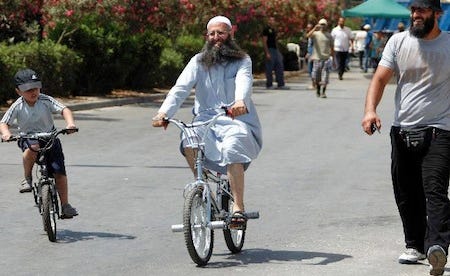
Taken for a ride..
To many people in Lebanon, sheikh Ahmad el Assir said the right things and fought for the right cause (finding a solutions to Hezbollah’s weapons of intimidation). But in the end, despite the media’s attention and the expressions of support on Facebook and Twitter, despite his stunts and attention-seeking antics, the fiery sheikh’s loquacious crusade crashed down unceremoniously. After realizing that he’ll never get the kind of traction he and his backers had hoped for, he packed up and moved his fight to Twitter.
What can the rise and fall of Ahmad el Assir teach us about Lebanon and Lebanese politics? Here are a few observations off the top of my head
The messenger matters more than the message
“The key to appreciating Assir is to avoid looking at him. It’s best to listen to him on the radio”, my aunt once helpfully suggested. My aunt is a non-veiled Muslim who teaches at a lycée. She looks nothing like the draped-in-black women in Al Assir’s protests, but she supported him because she liked what he was saying. But she won’t get anywhere near him, let alone protest with him.
So here’s the first lesson for Al-Assir wannabes: If your own supporters can’t even look at you without cringing, you’re probably not going to make it as a popular leader. I would even venture to say that it is the very disposability of Al-Assir that made him palatable to some people.
In Lebanese politics, publicity doesn’t matter
You have probably seen those photos of Al-Assir doing mundane and goofy things like eating ice cream and riding tiny bicycles. Such photos were shared endlessly online and are neatly collected in the blog “Sheikh Assir Doing Stuff”. Perhaps you think they’re candid photos that people are sharing to poke fun at him, but you might want to think again. Political campaign managers and Lady Gaga publicists would tell you that such photos are carefully planted to humanise the subjects and to keep the conversation ongoing about them.
We have now learned that in Lebanese politics notoriety does not necessarily translate into political power, and name recognition alone cannot move the mountain of established politics. Speaking of which:
Mainstream Politics still rules
There was a time when some of us thought that people like Al Assir can challenge traditional Sunni politicians in the upcoming 2013 elections. But we got our moment of truth during the special elections in Koura.
The lesson is that when the stakes are high and when real politicians compete, the game changes dramatically. We go back to the basics of retail politics: Ad buying on a spectacular scale, pressing flesh, community mobilization, campaign management and monitoring. If Ahmad el Assir even thinks of running against Najib Miqati or Saad Hariri, he will be drowned by their roaring electoral machines before he even begins.
People care about their livelihoods more than about politics
Sheikh Al-Assir was betting that Sunnis in Saida would rally to his cause, but in the end it was those very Sunnis who fought him because he was messing with their livelihoods by blocking a vital road and killing their businesses.
Comparisons were drawn to Hezbollah blocking the Beirut Central District in protest against the then Prime Minister Fouad Seniora, but unlike Hezbollah, Al-Assir’s camp was blocking the lives of his own supporters and he was betting on them sacrificing for the cause. That didn’t happen.
We’re all wise and Hezbollah is not dumb
One of the most important things in Al Assir’s demo was what didn’t happen: Nobody took the bait and nobody got angry and spoke back. No matter how much Al Assir tried to speak disrespectfully of Shiaa leaders and mainstream politicians, he did not receive the gift he was waiting for: A fight back. Instead, everyone ignored him and deprived him of the chance to paint himself as the Sunni martyr who was roughed up by the armed Shiaas.
Lebanon has graduated from a civil war and we are watching one unfolding before our eyes in Syria. We are primed to avoid conflict and to stay away from conflagrations. This is why Assir’s assumption that Hezbollah will respond to his provocations is not only an insult to our intelligence, but also an insult to Hezbollah’s strategic thinking and pragmatism.
Now that the Assir chapter is over, you could almost hear the other Lebanese politicians telling him: “Nice try kid, now is the time for the big boys to play”.