This post is more than 14 years old
Politics move quickly and opinions evolve. There's a good chance I no longer hold some of the opinions expressed in the post below
—Mustapha
The Sects that Divide Us
June 25, 2012 · Mustapha Hamoui
I was reading an interview with Maya Mikdashi about the situation in Lebanon and Syria, and I found this part:
In the press we often read about Lebanese Sunni allied with the Syrian Sunnis against the Asad regime, and Shi‘a Lebanese allied to ‘Alawis in Syria who are allied to Asad regime.
This is an extremely disingenuous and insufficient reading of what is happening. I think it is much more of a political dispute that is increasingly becoming sectarian as the uprising in Syria itself becomes more sectarian and is packaged in a way such that “sect” is the political marker that matters the most. I think that we need to be critical of this packaging. It is almost as if Arabs are not allowed to have ideological, ethical, political, economic, or social stances on current (and even historical) events. We (Arabs) have sects, not politics.
I am quite familiar with this worldview, and I often hear from its proponents when I write about Sunnis-vs-Shias in Lebanon and Syria. The general logic behind it is that sectarianism is something that other people did to us (colonialists, Americans.. etc). That if it weren’t for those strangers, we would be living in a perfectly secular world where politics are about issues, not religious loyalties. Note Mikdashi’s use of words like “packaged” and “allowed”, tell-tale vocabulary of the conspiracy inclined.
But then how does she explain this Pew Center survey:
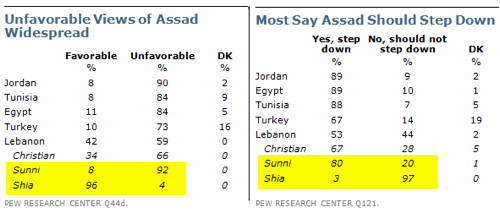
The overwhelming difference of perception between Lebanon’s Sunnis and Shiaas can’t be explained away as an “extremely disingenuous and insufficient reading of what is happening”. Religious affiliation is a very important part of the lives of many Lebanese and Syrians and it’s at the heart of the tensions in multi-religious Arab societies, from Bahrain to Lebanon.
Perhaps Mikdashi is blessed to be living among enlightened people who care more about policy than prophets, but from my vantage point here in Tripoli, the sectarian narrative is so dominant people no longer care about politically correct discourse. Even in public places, the discussion is about the rise of the Shiaas and the prosecution of the Sunnis. Giant posters in the middle of the city proclaim general Ashraf Rifi as the “protector of the Sunnis”.
Are there exceptions to this rule? Sure! There are admirable Alawites fighting against Assad, and there are Lebanese Sunnis who support him. But these are the exceptions, not the rule. They show up in the survey as less than 10% of the sectarian populations.
Do I like this state of affairs? Of course not. But if you want to have a proper reading of a situation, it is better to see it as it really is, not as some idealized version of what you wish it were.