This post is more than 14 years old
Politics move quickly and opinions evolve. There's a good chance I no longer hold some of the opinions expressed in the post below
—Mustapha
The Failure of Lebanon’s Facebook Demonstrations
May 22, 2012 · Mustapha Hamoui
Online mobilization is failing to take off in Lebanon.
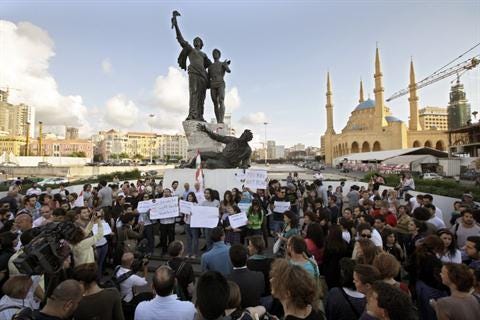
There were almost more journalists than people in the “say no to war” demonstration
When people started shooting at each other in Tripoli and Tarik el Jdide, the rest of the Lebanese were visibly angry. Residents were clamoring loudly on radio talk shows, on TV stations and on the internet for the insanity to stop. One thing they all had in common was an overriding sense of helplessness, a feeling that there was nothing they could do to stop people from throwing bombs at each other in the middle of an otherwise lively city.
Facebook and Twitter were supposed to change that. The silent majority was finally given tools to organize, gather and stop being so silent. All the peace-loving citizens of Beirut and Tripoli would “reject violence” and “say no to war” in an overwhelming wave of peaceful protests that would shame the fighters into peaceful coexistence.
But the crowds didn’t materialize. People didn’t show up. Not in Tripoli, not in Beirut. In yesterday’s “no to war” event, according to a report by Stephen Dockery for the Daily Star, only 100 person of the 2000 who pledged attendance on Facebook showed up. There were almost more journalists than demonstrators, he sighed.
The online bubble
The Beirut peace gathering (and its Tripoli counterpart) were extreme cases, but they were not isolated incidents. In fact they are part of a recurring theme in the last couple of years: Online activists plan major mobilizations for causes we cyber-warriors believe are universal: Women’s rights, domestic workers’ rights, laic pride, workers’ rights, no to war, no to marital rape, no to sectarianism. We convince ourselves every time that sensible people all over Lebanon will sign up. And not without reason: We get thousands of likes, retweets and forwards, “This time, it will be big!” online backslapping abounds.
But when the moment of truth comes, the actual demonstration is revealed as a shadow of its virtual self. Invariably, we get hundreds (never thousands) of well-meaning middle class, well educated people, most of whom are university students. Nothing to sneeze at for sure, but far from the earth shattering crowds that will change the game. It is instructive to compare the attendance with that in “festivals” organized by political parties.
The Triumph of the political party
In his critique of Lebanon’s Laïque pride movement, Walid el Houry wrote:
The group, like most of civil society movements in the country, both addresses and is composed of middle and upper middle classes (mostly university students and graduates). This fundamental shortfall can explain the group’s failure to incorporate economic demands and an alternative political and economic project that would put forth the interests and speak to the needs of the large segment of Lebanese workers, peasants and unemployed […] Mobilization requires reaching out to people whose economic situation does not allow them to see secularism as a valid demand
He concludes that real social change requires more than online activists. It requires political parties which offer comprehensive alternative plans. But plans are not the only advantage of political parties. In his critique of Egypt’s Facebook revolutionaries, Francis Fukuyama wrote yesterday:
(the Facebook liberals) could organize protests and demonstrations, and act with often reckless courage to challenge the old regime. But they could not go on to rally around a single candidate, and then engage in the slow, dull, grinding work of organizing a political party that could contest an election, district by district. Political parties exist in order to institutionalize political participation; those who were best at organizing, like the Muslim Brotherhood, have walked off with most of the marbles. Facebook, it seems, produces a sharp, blinding flash in the pan, but it does not generate enough heat over an extended period to warm the house.
In other words, it is one thing to click “Like”, and quite another to follow through to the end and get actual results.
Our moment of disillusionment.
Lebanese online activists continue to hope, but I guess it is time we take a deep look at our shortcomings. If there was something we really need to change, perhaps we should consider forming or joining a political party..