This post is more than 14 years old
Politics move quickly and opinions evolve. There's a good chance I no longer hold some of the opinions expressed in the post below
—Mustapha
A New Old Problem. Lebanon Should Start Worrying About its Debt Again.
May 10, 2012 · Mustapha Hamoui
The Lebanese debt issue is back to the forefront. Social stability will be its first victim.
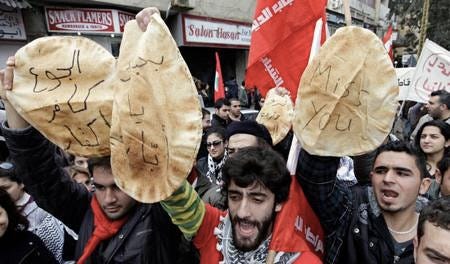
(Social instability is rearing its ugly head)
In case you haven’t noticed in the last few years, people and politicians have almost stopped talking about Lebanese national debt. What used to be a toxic political issue almost vanished as a talking point. It’s not because of fatigue or desperation, it’s simply because we were actually solving the problem.
Debts get easier to pay when countries grow as the debt becomes smaller as a percentage of GDP. Lebanon has been having an uninterrupted growth rally in the last few years. That reduced the debt from 168% of GDP in 2007 to 134% of GDP in 2011.
Double Trouble
Now, we are in danger of reversing that progress because of the events in Syria and because of the government’s policies.
The Syrian crisis has greatly impacted the Lebanese tourism and export sectors. The cheapest way for Arab tourists to come to Lebanon and for Lebanese goods to reach Arab countries was by land via Syria. With all the bombs, kidnappings and shellings, that is no longer a viable route. We get less people in Lebanese hotels and we send less apples to the gulf.
The other part of the problem is government policy. The Mikati government is constantly being pressured into populist measures like increasing the minimum wage and subsidizing fuel, measures that spike the debt without increasing growth. With an election year coming, we can expect even more government buying of people’s acquiescence with borrowed money.
The long haul
Things won’t be getting better soon: The Syrian crisis looks like a long-term problem and the Mikati government is set to stay in power as long as matters in Syria are not resolved.
As the debt increases and growth decreases, our cost of borrowing will become higher and the problem will become worse. There will be more pressure on the Lira to be devalued and social instability will become even more acute.
The IMF has noticed and has issued a warning. If no courageous measures are taken to reform the public sector, preferably with some sort of unity government, Lebanon seems to be heading towards a Greek drama: An unenviable position between a rock of debt and a hard place of social instability.