This post is more than 20 years old
Politics move quickly and opinions evolve. There's a good chance I no longer hold some of the opinions expressed in the post below
—Mustapha
Beirut and Dubai
April 30, 2006 · Mustapha Hamoui
Two Ex Lebanese money Ministers say Beirut should be more like Dubai.
When the then Prime Minister Najib Mikati formed his transitional technocrat government last year, he appointed Mr. Demianos Khattar to be his Minister of finance. This youngish, knowledgeable man with thick glasses appeared on a TV program today after a long absence from the public sphere. He was commenting on the current government’s performance and was criticizing Mr. Jihad Azour’s economic plan. The thing that caught my attention was what he said about the lack of creativity on the part of our government.
He said: (I’m paraphrasing)
Dubai has 19 free zones and Lebanon doesn’t even have one. Lebanese publishers and media companies are setting up businesses in those free Zones. I can’t see why the Lebanese government doesn’t create a media or publishing free zone with no taxes, no red tape, and high business incentives. In an age of cross-border services, why should our experts be working outside of their countries?
Mr. Khattar is not the only money-related Lebanese Minister who was asking for progressive economic action a la Dubai.
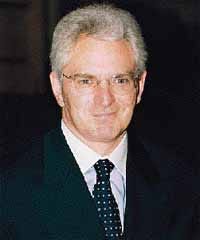
Mr. Nasser Saidi (pictured above), an Ex Lebanese Minister of Economy, the man who has his signature on the various Lebanese denominations, not only praises Dubai, but he walked the talk. He moved there to become Chief Financial Economist in the Dubai Financial Centre. The Washington Post ran a feature about Dubai today in which it spoke about Mr. Saidi:
The boom [in Dubai] has drawn the Arab world’s best and brightest, and many of its most influential expatriates speak with the force of the converted. Saidi is one. He recalled a generation of disappointments. In 1960, he noted bitterly, Egypt had the same per capita income as South Korea. More than a decade ago, when he returned to Lebanon after its civil war and served as a Central Bank official and later a government minister, he envisioned a Dubai model for Beirut. Those hopes were dashed by Lebanon’s intractable politics.
“What is attractive for me is they effectively told me that what you weren’t able to do in Lebanon, we’re going to open the door here,” he said from the 14th floor of a building aptly called the Gate, the cornerstone of the new International Financial Center.
He sees Dubai as the champion of greater economic unity in the Arab world, finally realizing the promises nationalist leaders made for 50 years that were broken by political divisions and economic failure.
How sad..
Is it a coincidence that neither Mr. Khattar (today a proud Aounist), Nor Mr. Saidi have ever worked under Prime Minister Hariri.? Could we draw any conclusions?