Beirut and Dubai


Uncategorized


Two Ex Lebanese money Ministers say Beirut should be more like Dubai.

When the then Prime Minister Najib Mikati formed his transitional technocrat government last year, he appointed Mr. Demianos Khattar to be his Minister of finance. This youngish, knowledgeable man with thick glasses appeared on a TV program today after a long absence from the public sphere. He was commenting on the current government’s performance and was criticizing Mr. Jihad Azour’s economic plan. The thing that caught my attention was what he said about the lack of creativity on the part of our government.
He said: (I’m paraphrasing)

Dubai has 19 free zones and Lebanon doesn’t even have one. Lebanese publishers and media companies are setting up businesses in those free Zones. I can’t see why the Lebanese government doesn’t create a media or publishing free zone with no taxes, no red tape, and high business incentives. In an age of cross-border services, why should our experts be working outside of their countries?

Mr. Khattar is not the only money-related Lebanese Minister who was asking for progressive economic action a la Dubai.
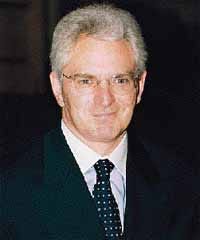
Mr. Nasser Saidi (pictured above), an Ex Lebanese Minister of Economy, the man who has his signature on the various Lebanese denominations, not only praises Dubai, but he walked the talk. He moved there to become Chief Financial Economist in the Dubai Financial Centre. The Washington Post ran a feature about Dubai today in which it spoke about Mr. Saidi:

The boom [in Dubai] has drawn the Arab world’s best and brightest, and many of its most influential expatriates speak with the force of the converted. Saidi is one. He recalled a generation of disappointments. In 1960, he noted bitterly, Egypt had the same per capita income as South Korea. More than a decade ago, when he returned to Lebanon after its civil war and served as a Central Bank official and later a government minister, he envisioned a Dubai model for Beirut. Those hopes were dashed by Lebanon’s intractable politics.
“What is attractive for me is they effectively told me that what you weren’t able to do in Lebanon, we’re going to open the door here,” he said from the 14th floor of a building aptly called the Gate, the cornerstone of the new International Financial Center.
He sees Dubai as the champion of greater economic unity in the Arab world, finally realizing the promises nationalist leaders made for 50 years that were broken by political divisions and economic failure.

How sad..

Is it a coincidence that neither Mr. Khattar (today a proud Aounist), Nor Mr. Saidi have ever worked under Prime Minister Hariri.? Could we draw any conclusions?

Entries (RSS)Do you like this post? Would you like to be always updated with new posts on this website? If so, please subscribe to this blog's RSS feed? (tell me more)


Discussion

No comments for “Beirut and Dubai”

  1. Aounist = stubborn idiot

    Posted by Anonymous | April 30, 2006, 7:11 pm
  2. i met Mr. Khattar when he was minister once for an issue concerning our field, and he was very helpful. He was very solution-oriented, and focused a lot on the input of those concerned.

    But again he wasnt there for a long enough time to judge his performance.

    Posted by Jamal | April 30, 2006, 7:31 pm
  3. Getting tired of saying it.

    Doen’t take a genius. Cut corruption and establish security.

    The economy and the country will do great.

    Forget about free zones and center for this and that. Useless gvmnt. meddling and spending.

    Posted by JoseyWales | April 30, 2006, 9:24 pm
  4. Dubai has done many good things and it will probably continue to adopt other policies that will go a long way in perpetuating its growth and solidifying its position as a financial and tourist center in its corner of the world. But Dubai has some major shortcomings also, the most important of which is the absence of a democratically elected government that can be held accountable to the stakeholders.

    Dubai can be viewed as a model by other Arab states, especially Lebanon, but only through a narrow prism.

    As for the FTZ’s they have a checkered history. Most international economists, including this one , don’t care that much for them. My point is quite simple and straight forward, if it is good to attract foreign capital and know-how then why keep it in a very narrow area? Why not adopt reforms and policies that will make the whole country attractive to foreign capital?

    Posted by ghassan | April 30, 2006, 10:37 pm
  5. Why not adopt reforms and policies that will make the whole country attractive to foreign capital?

    Indeed Ghassan, 93% of said reforms and policies are in my above post. ;)

    Posted by JoseyWales | May 1, 2006, 12:52 am
  6. Josey,
    I was agreeing with you and even demonstrating that your idea has numerous academic backers:-)

    Posted by ghassan | May 1, 2006, 3:55 am
  7. ghassan,
    > Why not adopt reforms and policies that will make
    > the whole country attractive to foreign capital?

    I am no claiming to be an international economist, but it seems to me that even though adopting the propper poicies and doing all the necessary reforms is better, it takes so MUCH more work and commitement to accomplish where as creating an FTZ, is much easier.
    So eefectively some people are saying we’d rather have a half solution now that is doable while others are saying we want a complete solution even if it is harder and takes longer to implement.

    Again, that’s all just my uninformed opinion.
    Pat

    Posted by Anonymous | May 1, 2006, 8:23 am
  8. ALso Mustapha,
    I am -almost- dissappointed hat Kattar is an proud Aounist, I liked him so much better than Aoun or anyone else for that matter.

    Oh well.
    Pat

    Posted by Anonymous | May 1, 2006, 8:28 am
  9. Ghassan, JW,
    What’s wrong with Free Trade Zones as a “foot in the door” policy?
    instead of going all the way in liberalizing labor and redtape all over the country (to the objections and stalling of the beneficiaries of the status-quo), you can build a small shining example that will create jobs and wealth, which could be used as “Exhibit A” for major future reform packages. Remember, reforms are not popular and people need to see why they have to go through all the trouble.

    Pat,
    Just because he’s Aounist doesn’t mean he’s a total idiot :)
    it could just be his way of voicing protest.

    Posted by Mustapha | May 1, 2006, 10:31 am
  10. Mustapha,

    Wasn’t Solidere’s BCD supposed to be such an “Exhibit A?”

    Posted by Anonymous | May 1, 2006, 10:36 am
  11. Mustapha,
    “A foot-in-the-door” policy is just that, a foot-in-the-door policy. It never matures and spreads. If reforms are needed then why introduce them on a selective , temporary basis into a very small area when some meaningful reforms could benefit the whole country and for a much longer period of time.

    Posted by ghassan | May 1, 2006, 2:54 pm
  12. I’ve got to disagree with Joseywales. Lebanon does need free zones, if it can even construct them. A free zone is a palatable political option, even if it is a silly concept (ie, why shouldn’t the whole country operate like a free zone?).

    The problem with Khattar’s statements is that he assumes the creation of a free zone will actually cause some change in Lebanon. I happen to work in the media and know very well the idiotic, constraining behavior of the Lebanese government. In fact, one of my projects failed because of Lebanese government bureaucracy and corruption. However, even with this aside, the telephone fees for calling abroad (even after they slightly lowered them) and the expense and low speed of the internet destroy any opportunity to make money compared to Dubai.

    If a media free zone was established, they should also establish an out-sourcing free-zone where French and English speaking Lebanese can take jobs away from French, Americans, Indians, etc. Once again, however, this would require entirely changing the telecommunications industry.

    Why is JORDAN now becoming the big outsourcing center in the Middle East? Because they have the best telecommunications infrastructure in the region, even if the majority of their population only speak English.

    Posted by Charles Malik | May 1, 2006, 5:14 pm
  13. Mustapha,

    You’re also on to something about Hariri’s economic policy. Sad to admit it, but the guy really was out to profit for himself and his buddies. He had little interest in reducing the tariffs that make it impossible to start a business.

    Here’s an example:

    I can only import two bottles of wine into Lebanon on my person without paying taxes. I can import one bottle of hard liquor (ie, vodka) and one other form of drink. Lebanon’s alcohol importation policy is much more open than many other countries, but that’s not the issue. If I import these bottles by having them sent to me, I have to pay taxes and “fees” which normally amounts to Port Authority corruption, etc.

    However, Hariri buddy Maurice Fadel can import as much alcohol as he can fit onto his private plane. Not only does the Lebanese government not closely inspect what is brought in on private aircraft, but Fadel is a member of parliament, which means he can do whatever he wants.

    If he turns around and starts a few businesses selling wine, all he has to do is pay the VAT. But he can get around even that.

    Hariri was not out for everyone’s interests. He was a businessman and wasn’t interested in allowing competition. Sadly, he was better than most of the others we’ve got running around.

    Posted by Charles Malik | May 1, 2006, 5:24 pm
  14. Mustapha,

    The Free Zones set-up in Dubai are called ‘free’ because you can have 100% foreign ownernship. Outside these small strips of land you need to have a local partner controlling 51% of the shares (or given a hefty bonus each year for his sponsorship). The reason I mention small strips of land is because this ‘cluster economy’ concept is based on three factors:

    1) Real Estate
    2) 100% government control
    3) Zoning & planning

    The government of Dubai owns these free zones through an entity called Dubai Holdings. Dubai itself is run as a corporation, under the direction of it’s ruler Sh. Mohammed. Since it is in essence a private company owned by the ruler, all the laws of government can be massaged to make business sense. They have one-stop-shop windows to take you through all the government requirements and then they lease you the land and/or the office. The market share for office space is taken from normal Tom, Dick & Harry outside the freezone without these protocols and siphoned into the free zones. Rents are currently skyrocketing as these are after all small strips of land. Furthermore there are a large number of ‘entrepreneurs’ using this system to launder money, using the empty offices as fronts. (just walk around media city and it becomes evident).
    Additionally, since Dubai is run by autocratic rulers, they can do this without anyone complaining.

    Lebanon is not in need of free zones of the media/internet/production variety. A cluster economy is not ideal. What is required is legislative and infrastructure development.

    I agree with lebanon.profile. Lebanon has an immense opportunity to develop a trilingual (if not more) outsourcing community. The government is just not able to see beyond it’s nose on this. Reduce complexity, increase security and the investors will come (and I am one of them!).

    It would be a shame to see Lebanon go this route. It is too suburban America.

    Furthermore, I believe in laissez-faire economics. The government should not be in the business of determining what the next cluster to be launched should be. Private enterprise should determine what is required and when. The government should only facilitate transactions. It should make it easy for the enterprising youth of Lebanon to easily set-up a business and get to work uninhibited. It should also work on getting back all the talent (and cash) that it has lost due to it’s inability to agree on who should use the executive toilet.

    Posted by the perpetual refugee | May 1, 2006, 6:56 pm
  15. May I recommend the following blog to you give you a glimpse into the Dubai underground.

    http://secretdubai.blogspot.com/

    Posted by the perpetual refugee | May 1, 2006, 6:58 pm
  16. Mustapha,
    I am offended by your implying that most Aounists are total idiots even though I am not one myself and even though I guess you didn’t mean offending.

    :-)

    Pat

    Posted by Anonymous | May 1, 2006, 9:46 pm
  17. LP and Steve,

    To be short I am is agreement with
    PerpRef.

    Furthermore, FTZ would be set up by our gvmnt and I don’t trust the gvmnt with it (or much or anything).

    The choice of regions would also make some people happy and others unhappy (and it would inevitably end up being sectarian).

    The pols would continually fiddle with the rules, and make them to benefit themselves.

    Lebanon just does not have the kind of economic handicaps that require these types of solutions.

    Posted by JoseyWales | May 2, 2006, 4:18 pm
  18. most of the people love lebanon ,,,they don t like dubai(it s all fake) sorry but dubai SUCKSSSSS!!!!
    BEIRUT is the best! and always be…

    Posted by amer | February 24, 2008, 9:02 pm
  19. we hate dubai

    Posted by amer | February 24, 2008, 9:04 pm
  20. dubai is ugly ….they think that dubai will be better than beirut!!!beirut is much better

    Posted by amer | February 24, 2008, 9:05 pm
  21. no matter what dubai will do beirut will be better …and the best in the middle east

    Posted by amer | February 24, 2008, 9:05 pm
  22. euuuukhhhhh!!!dubai ssssssssssucks

    Posted by amer | February 24, 2008, 9:05 pm
  23. dubai is all fake beirut is natural
    no body likes dubai like beirut

    Posted by amer | February 24, 2008, 9:08 pm
  24. boooooooooohhh dubai …no luck!

    Posted by amer | February 24, 2008, 9:09 pm
  25. dubai is triying too much but it s not working..
    beirut still the best
    no matter what ….yeah

    Posted by amer | February 24, 2008, 9:10 pm
  26. beirut rockkkkkkkksssssssss

    Posted by amer | February 24, 2008, 9:10 pm
  27. vibrant mightlife beirut

    Posted by amer | February 24, 2008, 9:10 pm
  28. week nighylife dubai
    booooooooooooh
    ugly …………

    Posted by amer | February 24, 2008, 9:11 pm

Post a comment

Hello, my name is Mustapha and I blog in The Beirut Spring about Lebanese society and politics. I started in February 2005 after the killing of P.M. Rafik Hariri.

Latest Posts

Bright Ideas From The Aounist Ministers
July 18, By Mustapha
Having It Both Ways.. Literally
July 17, By Mustapha
Lebanese Bloggers Not Happy With Kuntar Celebrations
July 16, By Mustapha
Why Walid Jumblat Has Embraced Samir Kuntar
July 16, By Mustapha

Recent Lebanon Video

WATCH: Lebanese Investments in Kurdistan

Lebanese Bloggers

Middle Eastern Bloggers

Naharnet RSS Feed

Yalibnan RSS Feed

NowLebanon RSS Feed

Latest Lebanese News

Blog Featured In